Kinetic Noir
High-Performance EV & Autonomous Mobility Studio
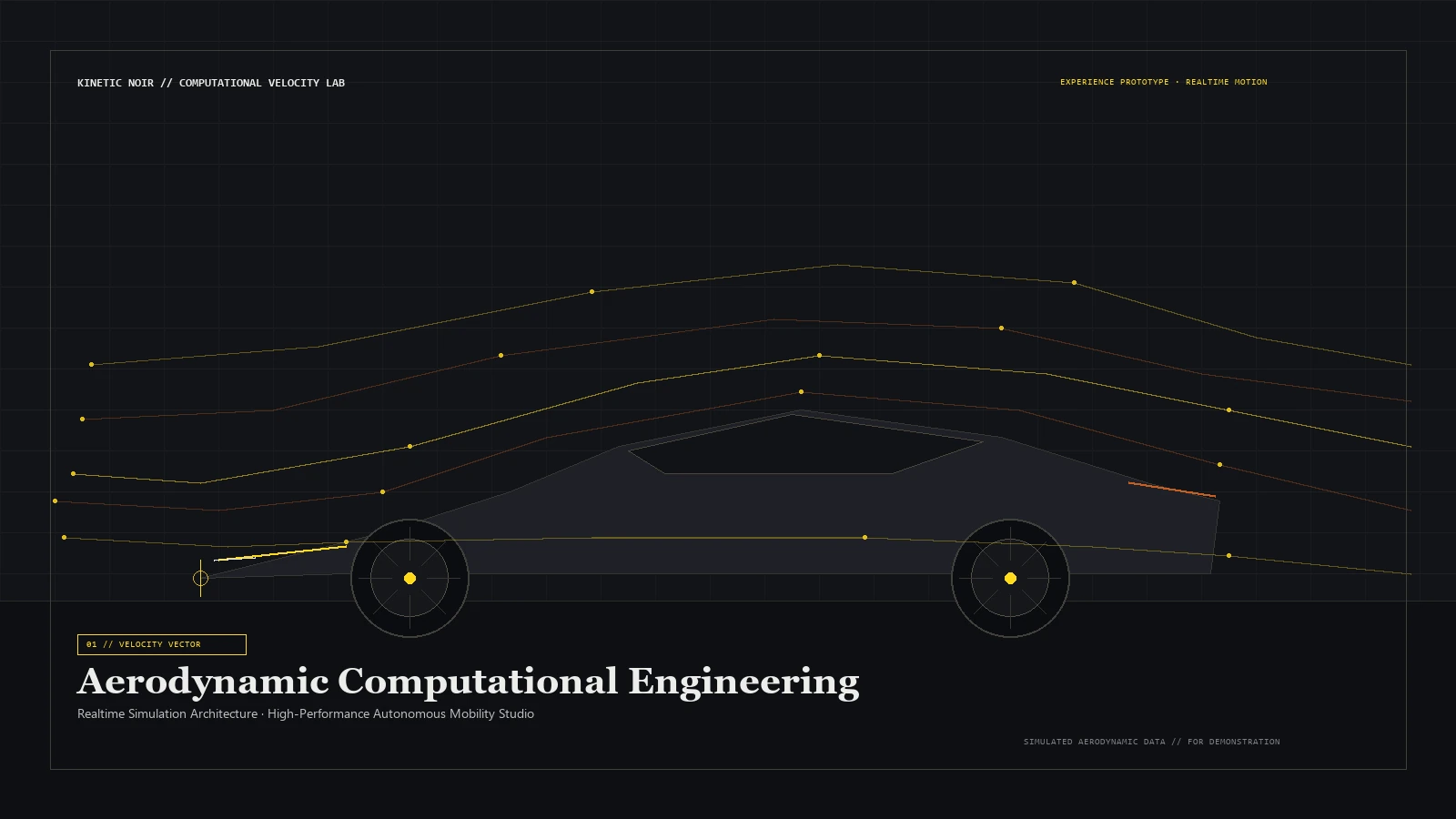
How do you make performance feel tangible before anything moves?
Performance brands traditionally communicate speed through static high-gloss photography and specification tables. Kinetic Noir explores another approach.
The digital environment behaves like the machine itself — responsive, aerodynamic, and computational. Rather than consuming pre-rendered media passively, the visitor inspects simulated wind-tunnel streamlines, platform chassis layers, and spring-mass interaction physics in realtime.
The Physics of Digital Velocity
Three core engineering disciplines that govern how performance is translated from the wind tunnel into interactive software.
Directional Tension & Flow
The digital composition inherits the same directional tension as aerodynamic design. Horizontal sightlines guide the eye across low frontal surfaces and rapid fastback tapers.
Telemetry as Aesthetic Language
Telemetry, flow fields, and technical notation become active elements of the visual identity rather than secondary metadata. Coordinates, streamlines, and vectors create genuine texture.
Acceleration, Damping & Inertia
Pointer, scroll, and touch responses use acceleration, damping, and spring inertia instead of synthetic binary easing. Interface elements carry physical weight and resistance.
Simulated Wind-Tunnel Flow Field
Conceptual 6-Layer Platform Architecture
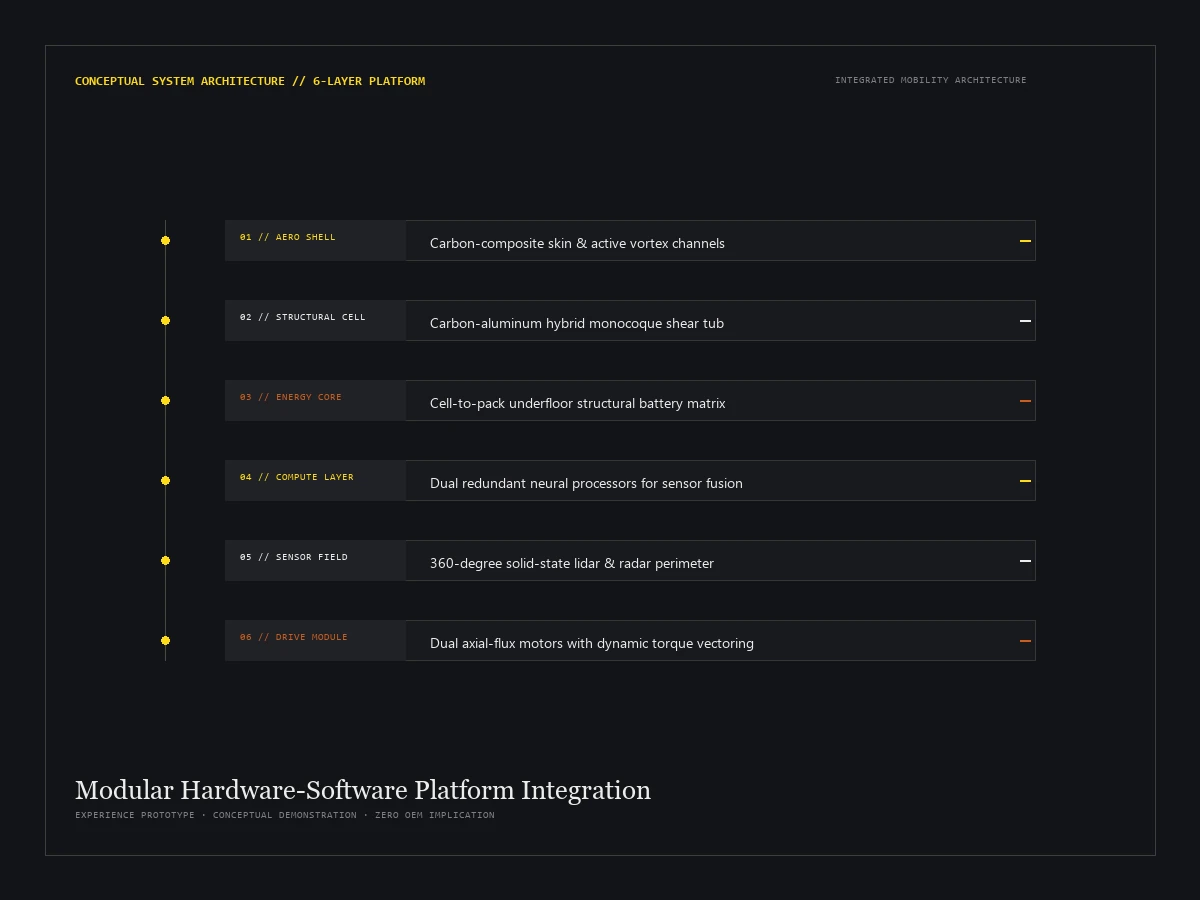
Monolithic dry-carbon exterior with molded internal venturi channels and conceptual variable aerodynamic surfaces represented across the outer envelope.
Conceptual carbon-aluminum structural cell featuring integrated front and rear shear bulkheads, engineered for structural battery integration.
Underfloor structural battery assembly concept forming the floor plane, featuring bidirectional micro-channel thermal cooling jackets.
Realtime automotive edge processing hardware concept running predictive trajectory modeling, sensor fusion, and active chassis telemetry.
Conceptual flush sensor integration designed to preserve the uninterrupted aerodynamic surface language.
Dual compact axial-flux motor architecture on front and rear axles with conceptual independent torque-vectoring architecture represented within the mobility platform.
Application of Computational Lab Principles
How experimental techniques from the ORVELUMM Lab — spring tension, magnetic displacement, and procedural lattice response — translate into a commercial mobility interface.
Proximity Spring Tension
Interface components react to pointer proximity dynamically, creating physical tactile feedback before click commitment.
Momentum & Damping
Moving elements inherit velocity and decelerate through realistic mathematical damping, avoiding unnatural robotic halts.
Procedural Dynamic Canvas
Visual surfaces react to interaction velocity, orientation, and motion state through lightweight canvas drawing algorithms.
How Interface Architecture Transcends Static Display
“Performance should not only be described. The interface should behave like performance.”
Adaptive Realtime Engineering
Design Objectives & Efficiency
Target 60fps frame budget on capable hardware with adaptive complexity scaling.
Interactive flow-field and wind-tunnel vector visualization without external video assets.
Automated IntersectionObserver suspension that preserves device battery and GPU resources.
Experience the Kinetic System
Kinetic Noir Mobility is an active ORVELUMM Lab project. Explore our public interactive experiments in the Experience Lab, or schedule a studio session for a private engineering demonstration.
Four Worlds. Zero Shared Templates.
We engineer custom digital flagships, interactive systems, and spatial web experiences.